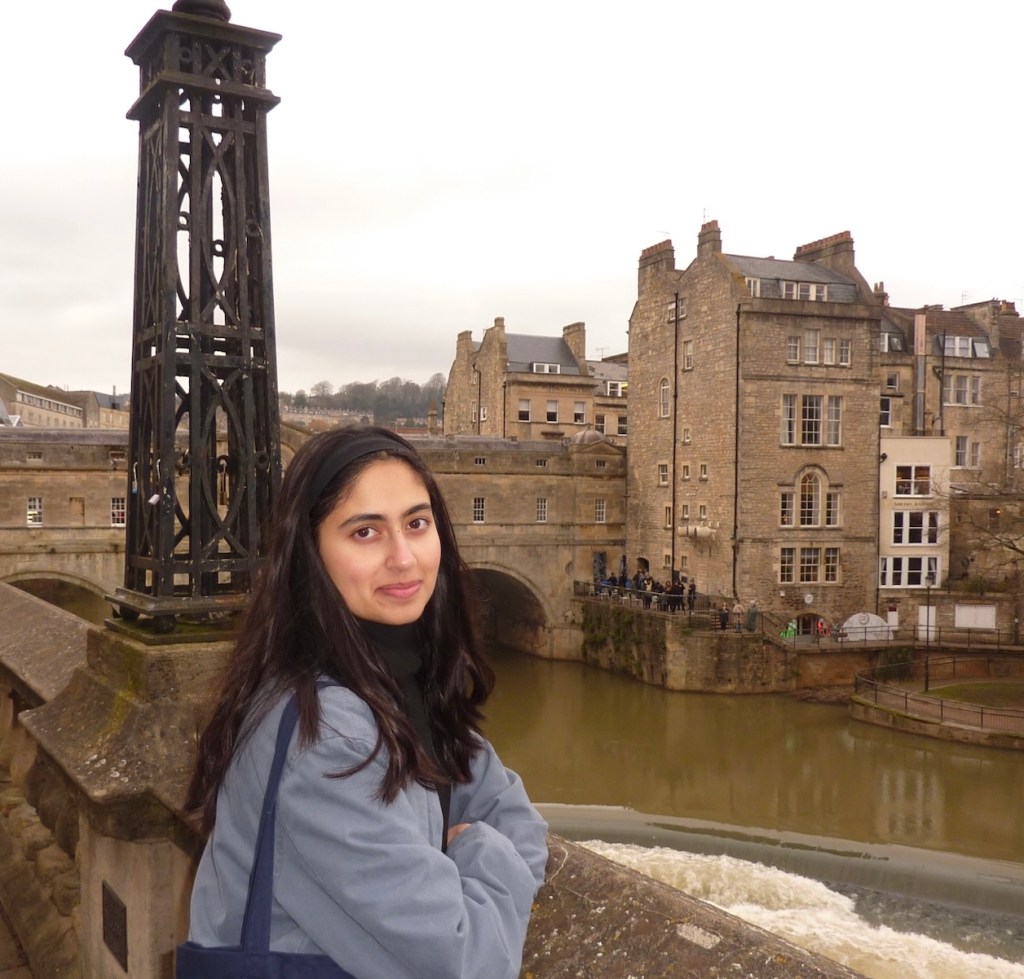
Ayisha is currently a PhD student in Epidemiology at the University of Oxford, an ocean away from the AP English classroom at FFCA where she nurtured her confidence in creative and critical writing. Ayisha completed her Master of Public Health in Epidemiology from the University of Toronto, and her Bachelor of Health Sciences in Health and Society from the University of Calgary. Ayisha enjoys new experiences, whether that be through reading, travelling, or hobbies.
“Shoot for the moon, even if you miss, you will land among the stars.”
Reading opened for me worlds beyond the one I was physically constrained to. The more books I devoured, the more my appreciation for the power of words grew, and the more I was open to alternate possibilities.
By the time university recruiters lined our high school gymnasium, a life of understanding the world through reading and writing felt like the obvious path for me. My dad had fostered my love of words throughout my childhood, taking my brothers and I to the library every weekend, asking about the books I was reading, and bringing home the daily newspaper from his job as a journalist. I admired his job and assumed he, if anyone, would understand my desire to study the humanities. To my surprise and disappointment, he disagreed and strongly encouraged me to pursue the sciences instead.
I found myself in the most humanities of sciences – the Bachelor of Health Sciences in Health and Society at the University of Calgary. I came to really enjoy the transdisciplinary program of studies; formulaic lab reports for my chemistry courses were a nice break from the exhaustive essays for my political science courses, and my research courses were an opportunity to merge the diverse skills I gained across all my courses in novel ways. Research, with its hypothesis building and testing, felt akin to storytelling. I particularly enjoyed the challenge of figuring out how we could test hypotheses given the limitations of human perceptions and tools.
With the aim of bolstering my methodological skillset for interdisciplinary research, I applied for a Master’s in Epidemiology immediately after graduating. The COVID-19 pandemic had reduced the final years of my undergrad to homeschooling, and I was keen for change. I decided to shoot for the moon and apply to the University of Toronto, home of the best school of public health in the country, never thinking in a million years I would get in. My “stars” were the University of Alberta and the University of British Columbia, both closer to home and less competitive. To say I was shocked when I received my offer of admission at U of T is a grave understatement.
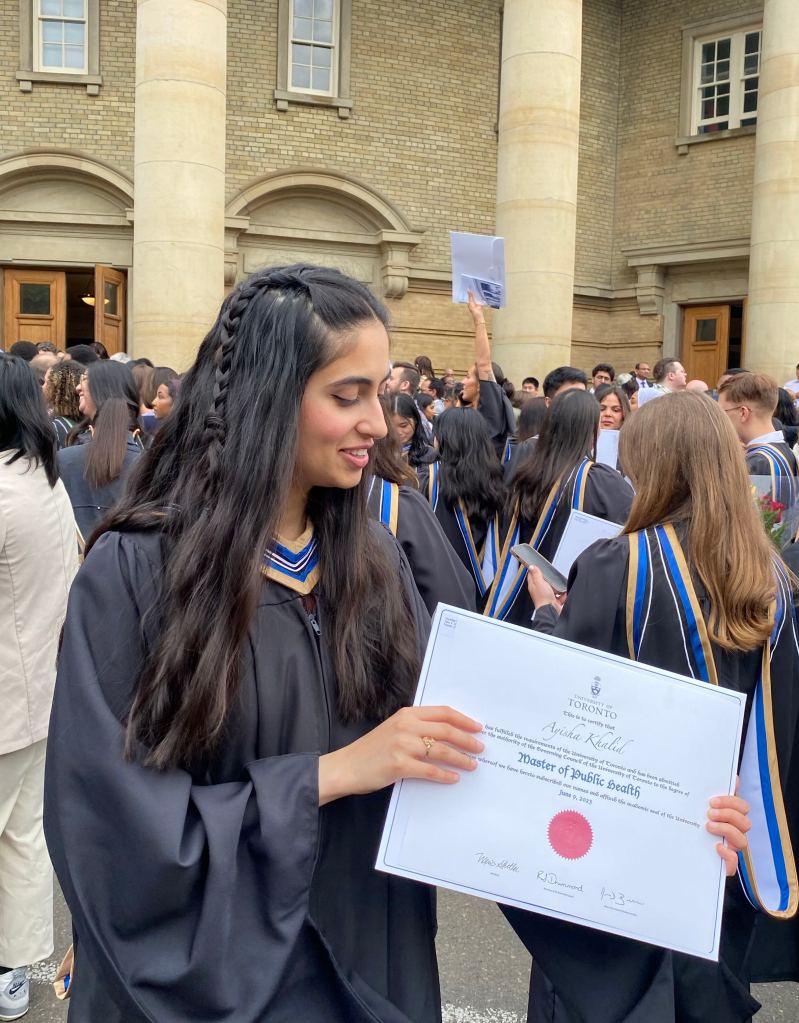
Besides academic validation from being admitted, I gained a lot from my time at U of T. My professors, especially for my epidemiological methods and biostatistics courses, built my abilities as an epidemiologist and did a fantastic job of it. I had the opportunity to apply these abilities through two practicum placements, where I was relieved to learn that I did, in fact, enjoy epidemiology, and in particular, my passion lay in infectious disease epidemiology. Just as novels do not always obey the rules of our world, infectious diseases pay no heed to manmade, political borders, and most infectious diseases jump across even the species border between animals and humans. I realized that only by taking apart the rules we have constructed could I begin to understand the stories of our world. I felt I had come full circle; epidemiology is a very journalistic pursuit.
Many things in life do not go as one imagines, but as the human imagination is limited, these things usually end up going better than one could have ever imagined. After finishing my master’s, I took up a job as an epidemiologist in Vancouver. I really enjoyed my work, and was pleasantly surprised to learn that having a full-time job is so much more liberating than being a full-time student. Even after reading and traveling to my heart’s content, I had ample time left over. I once again had the itch to shoot for the moon and used the newfound time I had to apply for a PhD in Epidemiology at the University of Oxford.
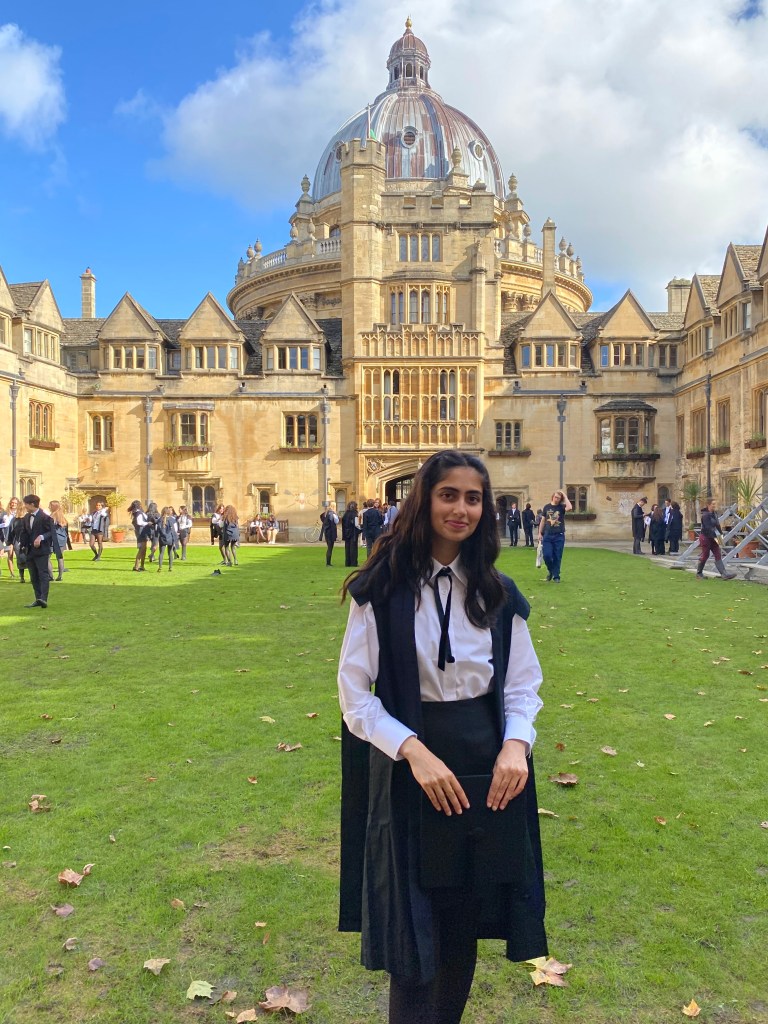
I am very grateful to say I once again landed on the moon. In October 2025, I will be starting the second year of my PhD at Oxford. My project aims to model the contribution of different population-level factors, such as migration and infrastructure, to the genetic diversity of the HIV pandemic over place and time. It is the optimal blend of the parts of science, math, and political science that I enjoy.
I am very happy with where I have ended up, but it is something 17-year-old me could have never envisioned. I remember in one of our leadership classes in grade 12 at FFCA, Ms. Sanderson made us do impromptu speeches about where we see ourselves in the future. I said something about wanting to be a professor, saying it would be very cool to be an expert in something and passionate enough to research and teach about it. I immediately followed this up with, “but that is such a far-fetched goal that would take so long to accomplish”, and Ms. Sanderson shook her head, saying something like, “do not say that, it is totally possible.”
It is a shame that the uncertainty of the future leads us to pessimistic self-doubt instead of optimistic hope. Nothing is outside of possibility, especially when one has access to the resources and opportunities that come with growing up in a high-income country. I learnt this through books and have affirmed it through my experiences. My biggest piece of advice to my younger self would therefore have to be, as cliché as it sounds, to “shoot for the moon, even if you miss, you will land among the stars”. Always give your dreams an honest shot; it is better to know that you tried and failed than to regret never trying at all. This is key to living with a clear conscience. Apply for the schools and scholarships and jobs you are uncertain about, because sure, what if you do not get it, but more importantly, what if you do!! Say yes more than you say no.
To my dad, who I thought was my enemy, stopping me from pursuing my dreams, thank you. You forced me to distill my passions and interests. I learned that I have an interdisciplinary mind, and I love to get paid to do science and math, and cherish my creative reading and writing as a hobby.
I would also thank myself for all the reading that opened me to different ideas and worlds. I am excited to see which celestial body I take on next.


 The Road Taken: Career Journeys
Leave a comment