
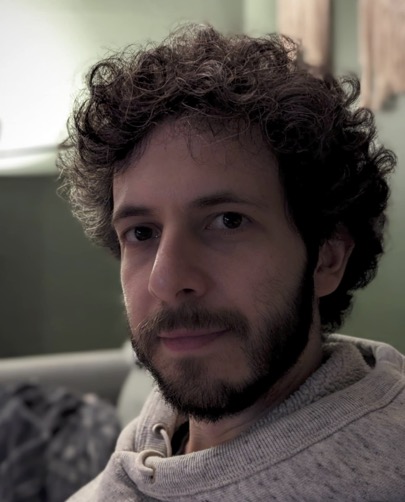
Welcome to the inaugural blog post featuring Nathan Budd, a student whom I had the pleasure of teaching in IB English and Theatre from 2001 to 2004. Through the years, Nathan and I have always kept in touch, and his meandering academic and career journey has always impressed and fascinated me. He epitomizes success, great wisdom, kindness, and humour! I’m honoured that he agreed to be the first contributor to this blog!
I was an OK student when I was a kid and became a pretty good one in high school. Any subject that wasn’t French came pretty easily to me. I loved math and the sciences especially, but I enjoyed English and tech courses as well. I was logical, good at reasoning, and loved working with my hands.
Being a good student at just about everything made it difficult to decide how to proceed at university. But I was going to university. That’s what good students do. Being good at logic and reasoning, and having some influential math teachers who made a big impact, I decided to throw my lot in with them. I would major in Mathematics when I started at McGill University. I had some IB credits to make my first year a bit easier, but it was not until my second year that I started taking courses in the Department of Mathematics: Analysis, Algebra, and Number Theory. I was very interested, but this was not the math I was used to from high school. Number Theory especially seemed so interesting and exotic, but so confounding and beyond me. It was the only course I ever failed. Well, I should have failed. I convinced the professor to give me a passing grade, because I would be transferring out of math – obviously, it wasn’t for me.
I looked at engineering. It had a lot of math, but the kind I was good at, like calculus and linear algebra. I applied to transfer to the Faculty of Engineering, but they rejected my application because of my grades. My grades were excellent, though, assuming you ignored the handful of theoretical math courses I had nearly and actually failed. I appealed their decision, asking them to consider my record without those courses, since they weren’t relevant to a career in engineering, and without them my grades were very good. In the meantime, I needed a plan B because it was not a sure thing that my appeal would overturn the original decision. Biology wasn’t my favourite science subject in high school, but I like knowing how things work, and I have a pretty good memory. And who could be disappointed with a career in medicine? My plan B would be to stay in the Faculty of Science but change my major to Physiology, with the intention of applying to medical schools after.
That whole appeal and plan B stuff happened over the winter break of my second year. I had to decide on my courses for the second term so I signed up for a few engineering courses that I would need if my transfer worked out. But by the time the Faculty of Engineering approved my transfer, I had grown tired of my engineering courses and had mentally moved on to my new career in physiology and medicine. I graduated with a major in physiology and a minor in mathematics and had conducted some undergraduate research. But before I graduated, I already knew that physiology and medicine were not for me. I could see the hunger and the drive in my peers. I did not want this as badly as they did. With how competitive med schools can be, I figured it wasn’t in anyone’s best interest for me to keep going down that path.
I felt lost.
The summer after graduation, I studied for and wrote the LSAT at my parents’ insistence: “Just in case.” I did pretty well, but I had little interest in law school, and even less after being dissuaded by my lawyer brother! After the LSAT, I backpacked through Europe for a couple of months. When I returned to Ontario, I moved in with some friends in Toronto. My plan was to work for a bit and get a taste of the working world for a change. I bussed tables at a restaurant for a few months. It was definitely a change of pace, but it didn’t even cover my expenses. Through a family connection, I was able to get an interview for a tech support position at a domain registrar and email service provider. That job paid much better and reignited my interest in technology and programming, which I had briefly explored in high school.
After about a year of working, I knew what I wanted to do next. I was going back to school for engineering. I had trouble deciding which engineering discipline to choose until I filled out the application for Toronto Metropolitan University (then Ryerson University), because aerospace engineering was at the top of the alphabetized list. I mean, what could possibly sound cooler than that?
I felt a bit rusty with my math and physics, so I opted not to accept any transfer credit from my first degree. I took all the courses a typical undergrad would take the first time around. I specialized in the space part of that program, taking courses in orbital dynamics, robotics, and rockets. I loved the topics. And again, I got myself into some undergraduate research projects. Funny thing though – I didn’t actually enjoy the research all that much. Come to think of it, I hadn’t enjoyed my research at McGill either. No matter. My partner at the time was gearing up for a PhD program in the States, and wouldn’t you know it, the graduate programs in aerospace in the States sure did look a lot more exciting than the ones back home in Canada.
I accepted an offer for a master’s program in aerospace engineering at Texas A&M University. It was exciting at first. The program had students from all over. The courses were interesting, but I did not like the research. Still, I might have stuck it out anyway, because that’s what good students do. But my relationship with my partner, who was in her own PhD program a few states over, was ending, and I felt even more lost and even less confident about what I was doing with my life than before. I didn’t end up finishing my research. I turned my research credits into course credits and left with a master of engineering degree (which is course-based) instead of the intended master of science degree (which is research-based).
That fall, I packed up my car and drove around the western States for 5 months. I zig-zagged north and south, slowly heading west from College Station, hitting up every state I could along the way. It was a lonely trip, but a necessary one. I needed some time to find myself again after all that time in school. After that ended relationship. After realizing I still had no idea what I should do with myself.
When I finally returned to Ontario, I felt like I had clarity. In hindsight, I think all I had was a slightly healed emotional state. Somehow, I convinced myself that I should give grad school another try. After all, that last attempt failed because my relationship failed. And because I hadn’t gotten on with my advisor that well. And because I was far from home. Right? I got back in touch with my TMU advisor, who was open to my joining his lab to start a PhD. I moved back to Toronto and got to work. Even though I didn’t enjoy it all that much, it was still very interesting, and I enjoyed some of the puzzle-solving, but it wasn’t really for me – I couldn’t see that, though. After a few months, I met someone and we got very close, very quickly. It didn’t take her long to notice that my work was making me miserable. We had many discussions and brainstorms on the topic. I decided I needed to leave school for good and pay a little more attention to my gut and a little less to my head.
After less than a year, I quit that PhD program and took a job with a family friend in the construction business. I was trying to get in touch with that long-neglected part of me that loved to work with my hands, to build things, and to be outside. He was a contractor, and I would be his assistant. Helping organize tradespeople, keeping tabs on schedules, getting materials, and generally just running around. While on the job one day, I saw a group of guys in a muddy hole, in the rain, nailing some boards together. They were building the forms that would hold the concrete that would become the footings of a new house. I think most people would have seen that tableau and not given it a second look. But I couldn’t look away. I just wanted to jump in the mud and help.
The contractor family friend put me in touch with the framers I had seen and got me a job apprenticing with them. I worked and learned with them for about 1.5 years. It was the most fun I’ve ever had earning a living. Part of me wishes I had started doing that right out of high school. I would have been so much further along by my early 30s. Getting started as an apprentice in your early 30s is a rude awakening financially. On top of that, our crew wasn’t unionized, so it wasn’t the safest work environment, and coming to it with a chronic back injury already, I eventually decided that this wouldn’t be a good fit for me long term. Prophetically, I decided to leave in the winter of 2019-2020 to pursue a career in software development. I had done a lot of coding in my engineering degrees and had enjoyed it. I was hoping to lean on that experience to get into the industry.
As I was applying to online postings, I discovered a job fair that looked to have a bunch of interesting companies. On the day of the job fair, COVID was a thing we had all heard of, but nobody was really worried. Some people weren’t shaking hands, and there was hand sanitizer everywhere, but there was a buffet table, and we were all sure this thing would blow over. I met a hiring manager there who thought my academic experience would lend itself well to learning on the job. She set up an interview for me on her team. By the time of my final interview, everyone interviewing me was attending remotely from their new makeshift home office.
So, I started my career in software from the luxury of my tiny shoebox apartment, without ever having to set foot in an office. I stayed with that company for 2.5 years. I learned a lot from the two teams I worked with during that time, but once the aura of learning new things wore off, I wasn’t all that thrilled with what we were building. The people I worked with were great, and the compensation was excellent, but I hoped to find something that could add the missing third element: meaning. Almost everybody needs software these days, but surely there were companies out there making a positive difference in the world. I’d prefer to work for one of them instead of toiling away on this thing that would not be missed if it suddenly stopped existing.
My partner at the time swore I must have horseshoes up my butt, because I found it: Audette Analytics – A startup, working to make the decarbonization of commercial real estate in the next 25 years a reality. Without this technology, there would be little hope of reducing the roughly 40% of global emissions generated from running our built environment. And wouldn’t you know, this company was full of the nicest people and they were willing to compensate fairly. I’ve been with them now for nearly 3 years.
Is there a lesson here? I don’t know. Certainly, I’ve been incredibly lucky. I’m intelligent, and people seem to like working with me, but I also benefited from family connections at a couple of critical moments. If not for those connections, I’d likely have had a very different path. Nobody can do much about those things, though. You’ve got the gifts and the connections that you’ve got.
One piece of advice does pop out to me, though: Don’t follow a path because that’s what you should do. I was a good student. Good students go to university. So that’s what I did. But university degrees are expensive and aren’t worth what they used to be. I think that I could have been very successful in a trade. In my spare time, I still make use of all the things I learned in carpentry by renovating my home.
It’s easy to get caught up in the prestige of a certain direction. People in your life may assure you that you’re making good use of your talents, but just because you can do something doesn’t mean you’ll enjoy doing it. I don’t like listening to the shoulds, and I don’t like the idea of following your passion either. I think these are red herrings. Shoulds are external and passions can change. I think you should just follow your gut. Follow what interests you right now. The direction that takes you might change over time. And that’s OK.
Nathan Budd – https://www.linkedin.com/in/nathanbudd/
aerospace engineering anthropology books broadcasting Business chemistry choice construction counselling creativity Data Analysis education English entrepreneur foster dog mom gap graphic design health healthcare journalism law school learning life marketing math Medicine mental-health Music nurse Nursing performing arts poem poems poet poetry Psychology school Social Studies software storytelling Sylvia Plath teachers teaching Writer Writing



 The Road Taken: Career Journeys
Leave a comment